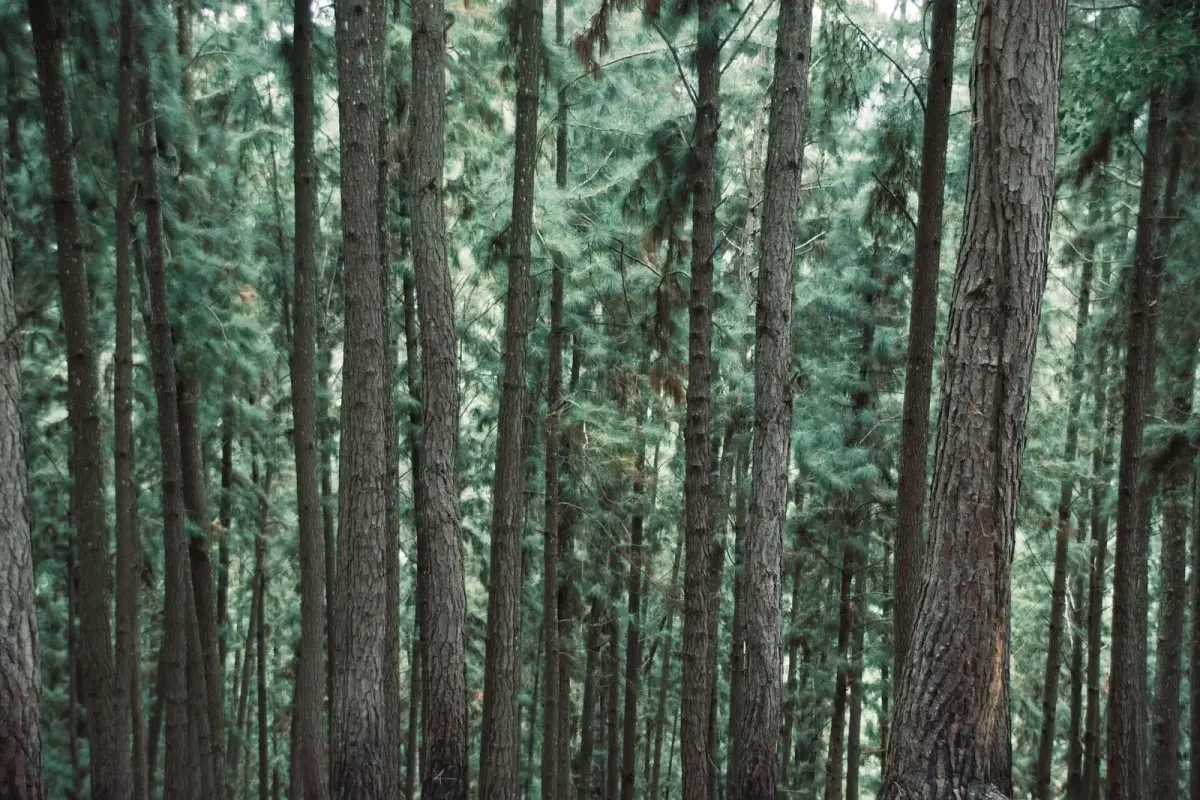
There is a pine wood on the hill behind the town that we walk through a few times a year, always with no particular aim. It was planted in rows decades ago and has since been left alone, so the trunks stand close and straight like the columns of a very large, very quiet building.
The sound changes
The first thing we notice is the floor. A thick carpet of needles takes the sound out of every footstep, and after a few minutes the noise of the road falls away. Conversation drops to half its volume without anyone deciding it should. The air smells of resin and, after rain, faintly of wet bark.
We do not take photographs in the wood, or very few. It is hard to photograph a feeling of enclosure, and the effort of trying pulls us out of it.
What we look at
Habit makes us look at structure. The trunks give a steady vertical rhythm, a little like a long wall of ribs, and the light that reaches us has been filtered through so many needles that it arrives green and even. It is the opposite of the harsh, patchy light of an open field, and it is kind to the eyes.
We also look low. Moss gathers at the base of the oldest trees, and small ferns hold on in the one or two places where the canopy opens. Seeing those details is the whole reason for walking slowly. At normal pace the wood is a green blur, and at our pace it takes the better part of an afternoon to cross.